
Essential pages checker
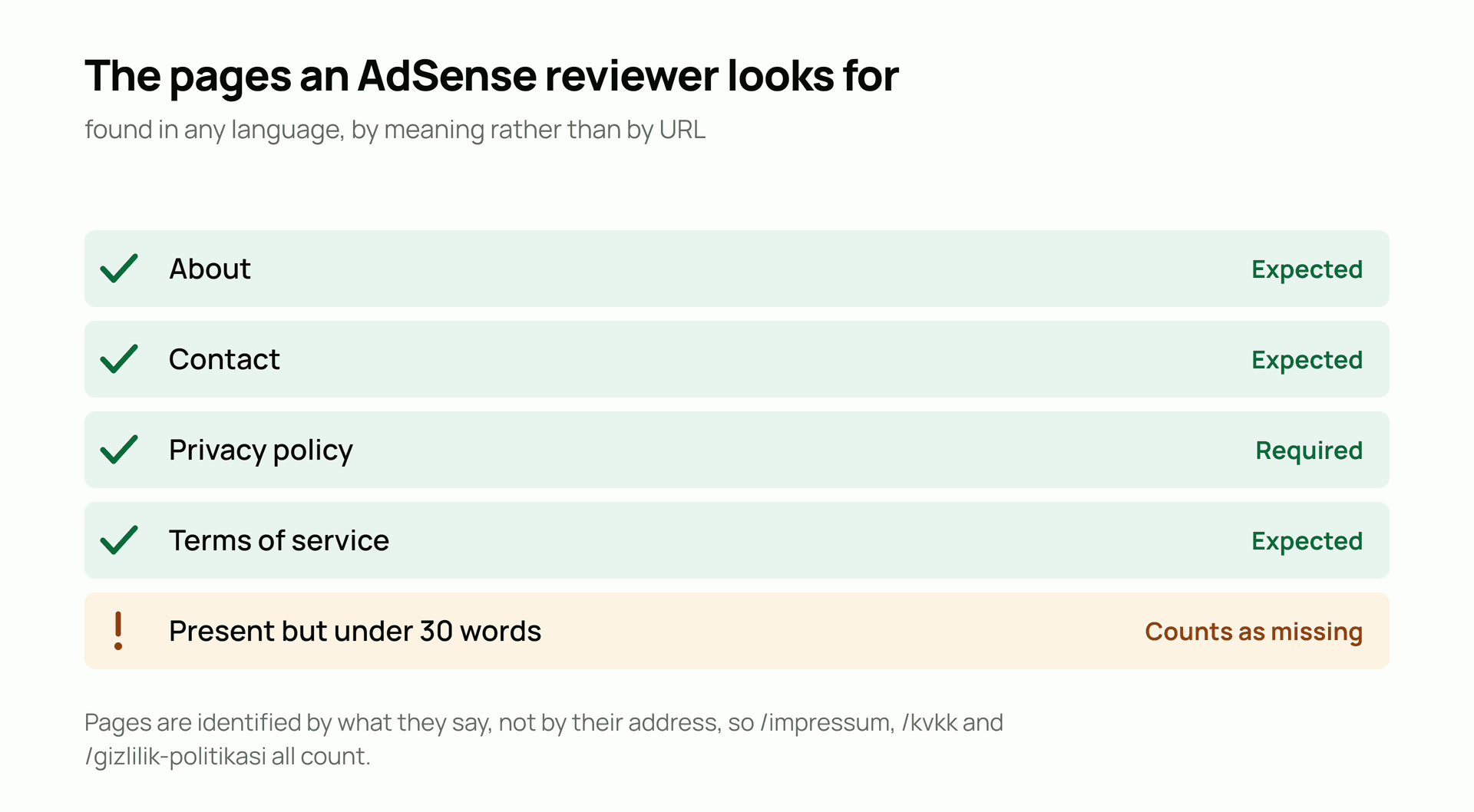
Checks for About, Contact, Privacy and Terms pages, detected in any language.
What TMOD checks
- Looks for About, Contact, Privacy, Terms, DMCA, cookie policy and disclaimer pages across the crawled site.
- Matches on URL patterns in several languages, including Turkish, German, Spanish and French variants, as well as on the anchor text of internal links.
- Confirms matches with an AI page classifier that reads the page content, so a page is identified by what it is rather than by what it is called.
- Reports which specific pages are missing rather than a single pass or fail, so you know exactly what to write.
Why it matters
These pages are the cheapest possible fix for one of the most common rejection reasons, which is why they are worth checking first. Writing an About page takes half an hour. Its absence can be the difference between approval and a rejection that gives no explanation.
The function they serve is establishing that a real, identifiable, contactable party is behind the site. A reviewer deciding whether to trust a site with ad revenue is asking who runs it and how someone would reach them if something went wrong. No About page and no Contact page makes that question unanswerable, and the safe answer is no.
A privacy policy is separately a legal requirement in most jurisdictions the moment you collect any data, including via analytics, and it is an explicit AdSense requirement, because serving ads means third-party cookies you have to disclose.
How to fix it
01Write a real About page
Who runs this site, why, and what qualifies them to. A few honest paragraphs from one person beats a page of corporate boilerplate. If it is a personal site, say so, a clearly personal site with a real name is more trustworthy than a vague implied company.
02Make Contact actually usable
A working email address or a form that sends somewhere real. A form that silently fails is worse than nothing. If you would rather not publish an address directly, a form is fine, but test it.
03Write a privacy policy that matches your site
Name the analytics, ad networks, embeds and hosting you actually use. State what is collected, why, how long it is kept, and how someone requests deletion. If any of it sets non-essential cookies, the consent mechanism belongs with it. A generic template listing services you do not use is a compliance problem of its own.
04Link them from the footer on every page
These pages need to be reachable from anywhere in one click. A footer link on every page is the convention, and it is also how both crawlers and reviewers expect to find them.
What each page has to actually say
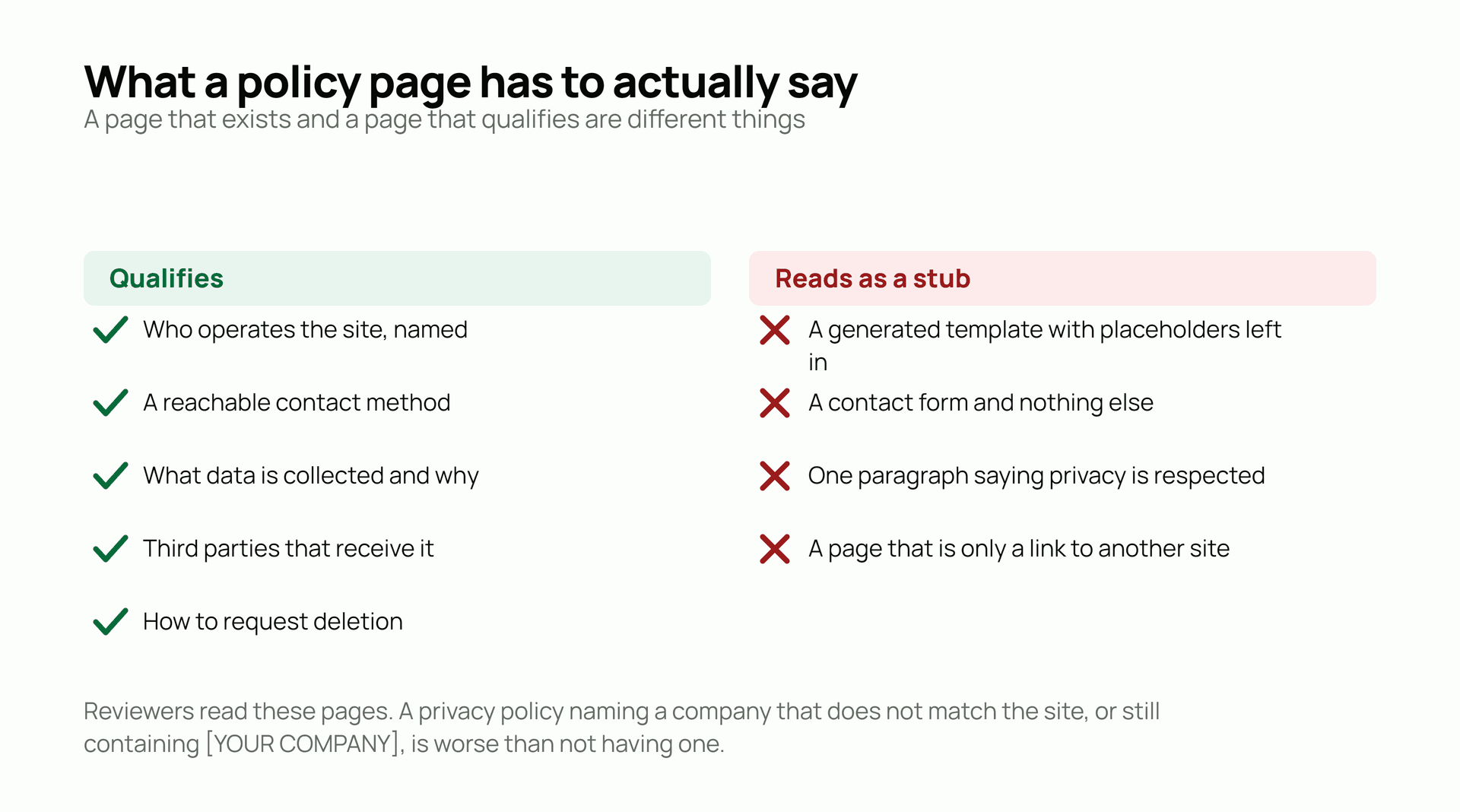
About is the one people write badly. It is not a mission statement, it is an answer to who is behind this and why should I believe them. A name, what you do, how long you have done it, and why this subject rather than another. If the site is one person, say so plainly. A clearly personal site under a real name reads as more trustworthy than a vague implied company, not less.
Contact needs one channel that a stranger can use and that reaches you. An email address or a form that has been tested this year. If you run a business, the registered address and company details belong here too, and in several jurisdictions they are required rather than optional.
Privacy is the one with a defined shape: what is collected, why, who receives it, how long it is kept, and how someone exercises their rights. Terms matters as soon as there are accounts, purchases, comments or submissions, and is genuinely optional for a site that only publishes. The policy audit reads these pages for substance rather than counting them.
How a reviewer and a crawler find them
Existence is not enough on its own. These pages have to be reachable in one click from anywhere, which in practice means a footer link on every template, not a link that only appears on the homepage. They should be plain HTML pages, not modals, not PDFs, and not blocked or noindexed by a rule aimed at something else.
Name them in the language the site is written in. Detection here handles multilingual naming deliberately, because a Turkish site with a page called Hakkımızda has an About page and an English URL pattern would have missed it. What matters is that a human reader recognises the link and the page delivers what the link promised.
One last thing worth knowing: these pages are excluded from the thin-page count so that a legitimately short contact page does not count against you. That exclusion is a courtesy, not a licence. A two-line About page passes the length check and still fails the job it exists to do, which is convincing someone that there is a real party behind the site.
The three pages, drafted in an afternoon
The About page for a one-person site takes four paragraphs. Who you are, by name. What the site covers and the one-sentence reason it exists, I started keeping bees in a suburban garden in 2019 and could not find advice that matched a small plot, is a complete origin story. What qualifies you, which for a hobby site is honest experience rather than credentials: five seasons, three hives, two swarms recovered. What a reader should expect, how often you publish and what you will not cover. A photograph helps and a real name does more. The whole page runs 200 words and does its entire job.
Contact needs one working channel and proof it works. An email address on your own domain, or a form, and if it is a form, send yourself a test through it today rather than trusting the plugin that rendered it. If the site is a business, the registered name and address belong here, and in several jurisdictions they are legally required on commercial sites rather than optional. The page can be five lines long. What it cannot be is decorative.
The privacy policy is the one not to write from memory. Start from an inventory instead: open your own site with the browser's network panel and list every third-party domain it calls, analytics, ad scripts, embedded video, hosted fonts, comment avatars. Then write one short paragraph per service, what it receives, why, and where its own policy lives, plus how long you keep anything submitted through forms and how someone asks for deletion. That inventory-first method is exactly what the compliance check rewards, because it reads the page for substance, and a policy derived from the real site has it while a template does not. If any of those services set cookies for EU visitors, the consent mechanism is the companion job.
Wire all three into the footer template so they appear on every page, then click them from an article page rather than the homepage to confirm the links actually shipped site-wide. Half a day of work in total, and it permanently retires the most common fixable rejection cause an application runs into. Very few improvements on this site's whole checklist buy more for less.
Questions
Does it matter what I call these pages?
Not much. Detection combines multilingual URL patterns, internal link anchor text, and an AI classifier that reads the actual content, so a page called 'Who we are' or 'Hakkımızda' is recognised. What matters is that the page exists, says what it should, and is linked from your footer.
Do I need a Terms of Service page?
It is checked but weighted less heavily than About, Contact and Privacy. For a site that just publishes content with no accounts, no purchases and no user submissions, terms of service is genuinely optional. The moment you have logins, comments, or anything transactional, it stops being optional.
Can I use a privacy policy generator?
As a starting point, yes, but you must then edit it to describe your actual site. The most common failure we see is a generated policy that mentions services the site does not use while omitting the ad network it does. The compliance check reads the content, and so would a regulator.
Do I have to publish a postal address?
For a personal blog, generally no: a working email or form is the floor an AdSense reviewer cares about. Commercial sites are different, several jurisdictions require operator details on business sites, Germany's Impressum requirement being the well-known example, and consumer law usually demands more again if you sell anything. If the site earns money and you are unsure what applies where you operate, that specific question is worth a professional answer.
Should these pages be indexable, or can I noindex them?
Leave them indexable. There is no penalty for legal pages being in the index, and noindexing them buys nothing while creating a small risk: a reviewer or a checker reaching the site through search sees a site without them. What actually matters is reachability, a footer link on every template, so that any page is one click from your About and Privacy pages. The one variant worth avoiding is putting them behind a JavaScript-only route that serves no content without a browser.
Read more
Screaming Frog, Ahrefs and Sitebulb for AdSense readiness
The big SEO crawlers are better at technical auditing than any AdSense tool. They are also scoped to a different question. Here is where the line falls.
The robots.txt lines that quietly block ad crawlers
Blocking Mediapartners-Google costs you ad revenue while the site keeps ranking normally, so nothing looks wrong. Here is how to read the file.
What AdSense means by "low value content"
The rejection reason gives you nothing to act on. Here is what reviewers are actually looking at, and the order to fix it in.